Global buyers rarely choose equipment cords by price alone. They examine safety, compatibility, durability, and supply reliability. A cord may look sturdy on a warehouse shelf, yet fail under heat, repeated bending, or heavy equipment loads. Fit matters.
John Drengenberg, former Consumer Safety Director at UL, offers a practical warning: “A damaged cord should be replaced, not repaired.” His advice reflects a wider purchasing reality. Reliable equipment cords need suitable voltage, current, temperature, connector, and jacket specifications. They should also match the destination market’s approved plug configuration and certification requirements. Details decide.
This introduction explores the leading cord types for international buyers. It considers IEC appliance cords, detachable power cords, medical-grade options, outdoor-rated designs, and customized assemblies. Each type serves a different working environment. A hospital cart needs controlled leakage performance. A factory motor may need tougher insulation and stronger strain relief. A retail appliance may prioritize compact packaging and regional plug options.
Standards matter. Verification matters more.
Buyers should review manufacturer test reports, material data, and traceability records before placing large orders. They should confirm whether certifications apply to the complete assembly, not only individual components. That assumption fails surprisingly often. Even experienced purchasing teams can overlook bending radius, storage conditions, or connector locking strength.
There is no perfect universal cord. The best choice depends on equipment design, operating conditions, destination requirements, and expected service life. Careful comparison reduces returns, downtime, and avoidable safety concerns. It also supports more dependable global sourcing.
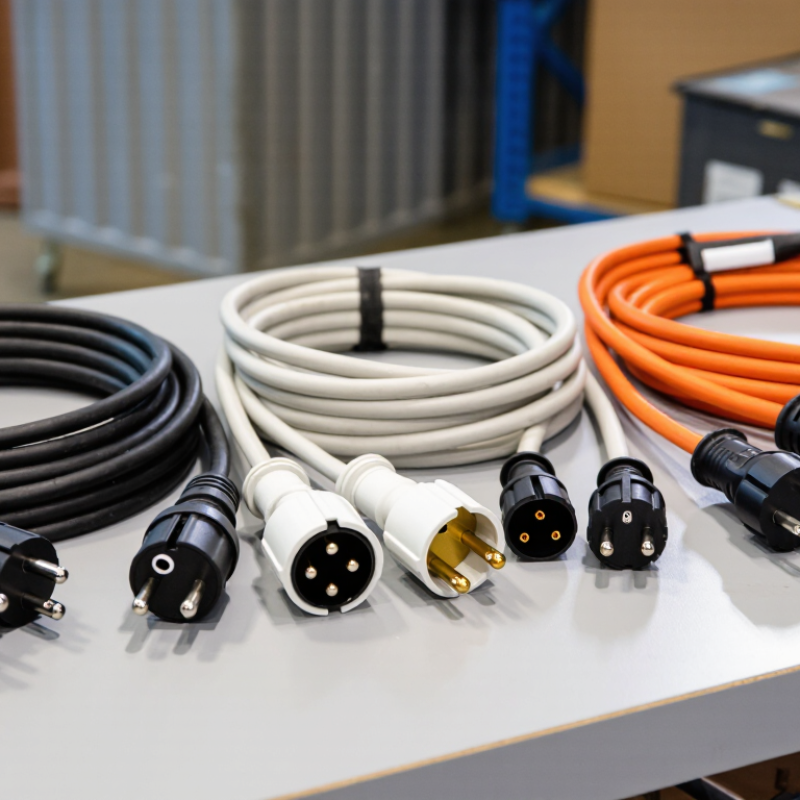
Equipment cords connect powered machines to a safe electrical supply. They may be detachable cords, regional plug cords, extension assemblies, or locking cords. IEC 60320 standards classify common appliance couplers by voltage, current, and temperature conditions. The best choice depends on the equipment, not only the plug shape.
Global buyers should check destination voltage, frequency, grounding, connector type, cable length, conductor size, and insulation rating. A grounded cord is essential for many metal-bodied machines. High-temperature equipment may require heat-resistant insulation. The IEA Electricity 2024 report expects global electricity demand to grow by about 4% annually from 2024 through 2026. More electrical equipment means more attention to cord reliability. Yet, a cord can look suitable and still fail under heat, vibration, or continuous loading. This detail is easy to overlook.
Tips: Request test reports, material specifications, and certification records before ordering. Confirm whether approval applies to the complete cord assembly. Ask for samples and inspect strain relief, connector fit, markings, and conductor flexibility. Keep regional variants clearly separated in storage. A small labeling error can delay installation. Buyers should also review local import rules and socket requirements with a qualified electrical professional. Perfect sourcing is unrealistic; documented checks are more dependable than assumptions.

Equipment cords vary by current, connector shape, environment, and service access. IEC 60320 C13/C14 cords remain common for monitors, office servers, and light-duty control cabinets. They are easy to replace and suit many 10–15 amp applications. C19/C20 cords support higher loads in rack servers, storage systems, and networking cabinets. The International Energy Agency’s Electricity 2024 report estimates that data centers used about 460 TWh globally in 2022. Demand may reach 620–1,050 TWh by 2026. Higher-density racks make correct C19/C20 selection increasingly important.
Regional plug cords, such as NEMA configurations in North America, connect equipment directly to local outlets. IEC 60309 industrial cords serve workshops, production floors, and outdoor equipment. Their robust housings resist impact, dust, and moisture better than ordinary office cords. Locking connectors can prevent accidental disconnection near pumps, test benches, or mobile machinery. Extension cords still have a role, but their length, conductor size, and temperature rating require careful review. The U.S. Consumer Product Safety Commission reported thousands of emergency-department injuries linked to extension cords and power strips each year. That figure deserves attention. A cord that fits may still be unsuitable. In practice, buyers should verify voltage, amperage, grounding, connector temperature, cable gauge, and destination-country certification. I sometimes see cord selection treated as a minor purchasing detail. It is not. Small mismatches can create heat, downtime, or an unsafe installation.
Choosing an equipment cord is a specification exercise, not a plug-shopping exercise. Start with the equipment nameplate: rated voltage, frequency, current, and power. Then check inrush current, duty cycle, ambient temperature, bending, and connector geometry. A 10 A cord may still fail when a motor draws a brief startup surge. Shorter is safer, when heat and movement remain manageable.
The IEA’s Electricity 2024 report projects global electricity demand to grow by about 4% annually through 2026. Its Global Energy Review 2025 records 4.3% growth in global electricity demand during 2024. More connected equipment means tighter cord selection. Match the plug and coupler with the destination market, then verify applicable requirements under IEC 60320 and IEC 60884-1. Check conductor size, insulation rating, temperature range, flex-life rating, and strain relief. Outdoor equipment may also need suitable ingress protection.
A neat spreadsheet still misses installation reality. Measure the actual route. Leave no sharp bend near the connector. Do not treat certification marks as proof of universal compatibility; approvals can be limited by country, application, or cord construction. The uncomfortable part is that many purchasing errors begin with an incomplete equipment label. Ask the manufacturer for maximum current, leakage limits, and operating conditions before ordering. Recheck every value against the final cord assembly, not only the loose cable.
What Are the Top Equipment Cords for Global Buyers?
Global buyers should match equipment cords to plug geometry, voltage, frequency, and local safety rules. Plug shapes vary widely, including Type A, C, F, and G configurations. IEC 60038 lists standard low-voltage systems, including 230/400 V and 120/208 V arrangements. A 230 V cord is not automatically suitable for every 230 V installation. Frequency also matters for motors, timers, and heating equipment. Check the label.
For detachable connections, IEC 60320-1 addresses appliance couplers, ratings, and safety requirements. Household plugs and socket-outlets fall under IEC 60884-1. IEC 60529 defines IP ratings for protection against dust and water. These ratings guide selection, but they do not replace destination-country approval requirements. The IEA Electricity 2024 report projects global electricity demand to rise by 3.3% annually from 2024 through 2026. Growing demand may increase procurement pressure. Small mismatches become expensive.
Choose a cord rated for at least the equipment’s maximum current draw. Confirm conductor size, insulation temperature, grounding, bend radius, and plug approval. A 120 V product connected to 230 V can fail dangerously without proper conversion. Adapters change plug shape; they do not necessarily change voltage or frequency. This is where many buying guides oversimplify. A careful review should compare the nameplate, test reports, and installation environment. Even then, uncertainty remains when suppliers provide incomplete documentation. Pause before ordering.
| Plug Type | Typical Markets and Regions | Nominal Voltage | Frequency | Grounding Arrangement | Common Equipment Cord Configuration | Key Safety and Compliance Considerations |
|---|---|---|---|---|---|---|
| A | North America, Central America, parts of the Caribbean, and Japan | 100–127 V | 50 or 60 Hz | Two flat blades; no protective earth | Two-conductor cord for double-insulated, low-risk equipment | Use only with equipment designed for unearthed operation. Voltage and frequency differ between Japan and other Type A markets. |
| B | North America, Central America, parts of the Caribbean, and Japan | 100–127 V | 50 or 60 Hz | Two flat blades plus a grounding pin | Three-conductor grounded cord for appliances with exposed conductive parts | Grounding continuity, correct polarity, strain relief, and appropriate national plug certification are essential. |
| C | Continental Europe, parts of Africa, South America, and Asia | 220–240 V | 50 Hz | Two round pins; generally unearthed | Two-conductor Euro-style cord for low-power, double-insulated equipment | Pin diameter, spacing, insulation, and permissible current must match the applicable national plug standard. |
| E | France, Belgium, Poland, Czechia, Slovakia, and some neighboring markets | 220–240 V | 50 Hz | Two round pins with a socket-side earth contact | Grounded cord compatible with Type E receptacles; many hybrid plugs also support Type F sockets | Protective-earth contact must engage reliably. Confirm compatibility where recessed or hybrid receptacles are used. |
| F | Germany, Austria, the Netherlands, Spain, Portugal, Sweden, and much of Europe | 220–240 V | 50 Hz | Side earth clips, commonly known as the Schuko arrangement | Grounded cord for household appliances, office equipment, and general electrical products | Verify earth-contact geometry, plug dimensions, current rating, and national approval requirements. |
| G | United Kingdom, Ireland, Cyprus, Malta, Malaysia, Singapore, and several Gulf markets | 220–240 V | 50 Hz | Three rectangular pins with a protective-earth connection | Three-conductor grounded cord; fused plugs are common in the United Kingdom and related markets | In applicable markets, the plug may require an integral fuse, shutter operation, insulated live and neutral pins, and approved cable construction. |
| I | Australia, New Zealand, China, and selected Pacific markets | 220–240 V | 50 Hz | Two angled flat blades; grounded versions include a vertical earth pin | Two- or three-conductor cord depending on equipment insulation class | China and Australia/New Zealand use related but different approval systems. Confirm plug dimensions, pin insulation, and local certification. |
| J | Switzerland and Liechtenstein | 220–230 V | 50 Hz | Three round pins with an offset earth pin | Grounded Swiss-market cord or compatible low-power unearthed cord | Swiss plug geometry and national safety approval should be checked separately from general European Type C or Type F compatibility. |
| K | Denmark and Greenland | 220–230 V | 50 Hz | Two round pins with a dedicated earth contact | Grounded cord for equipment requiring protective earth | Do not assume universal interchangeability with Type E or Type F. Verify the earthing arrangement and receptacle interface. |
| L | Italy, Chile, and selected markets | 220–240 V | 50 Hz | Three in-line round pins; versions differ by current rating | Three-conductor grounded cord, commonly selected according to 10 A or 16 A interface requirements | Pin spacing and current-rating version must match the destination receptacle. Avoid selecting solely by country name. |
| M | South Africa, Eswatini, Lesotho, and selected southern African markets | 220–240 V | 50 Hz | Three large round pins with protective earth | Heavy-duty three-conductor cord for higher-current appliances and equipment | Check conductor cross-section, plug temperature rise, rated current, earthing continuity, and destination-market approval. |
| N | Brazil and South Africa in designated applications | 100–240 V depending on country and installation | 50 or 60 Hz | Three round pins with protective earth; current ratings vary by configuration | Grounded cord selected for the applicable national socket and current rating | Brazil has multiple supply voltages and local plug requirements. Confirm voltage, pin dimensions, current rating, and certification before shipment. |
What Are the Top Equipment Cords for Global Buyers?
When comparing equipment cord suppliers, begin with the application, not the catalog photograph. Record voltage, frequency, current rating, plug type, connector shape, cable length, and jacket material. A laboratory device may need a flexible, heat-resistant cord, while warehouse equipment may require stronger abrasion protection. Check conductor size and bend radius carefully. Small details can prevent expensive failures.
Ask each supplier for a clear technical datasheet, inspection procedure, and production lead time. Request samples that match the final specification, including plug configuration and cable marking. During evaluation, compare insulation thickness, terminal quality, strain relief, and packaging. Reliable suppliers should explain test methods and provide traceable reports. Verify country-specific safety requirements before ordering, because approval marks and documentation can differ between markets.
My own early sourcing comparisons focused too heavily on unit price. That was a mistake. Freight, customs paperwork, minimum order quantity, and replacement costs changed the real total. Ask for quotations using the same delivery terms and shipping destination. Confirm carton dimensions and labeling before production begins. A small pilot order is often wiser than a large commitment, although it may increase the initial cost. Keep written approval records, inspect the first shipment, and review defects honestly. Suppliers can make errors. Buyers can miss them too.
The chart compares commonly specified equipment-cord connector families by nominal maximum current rating. IEC 60320 C13 and C19 are widely used for computers, servers, and power distribution equipment, while C5 and C7 are intended for lower-power devices. NEMA 5-15 is commonly used with equipment designed for 120 V systems. Before ordering internationally, confirm the required plug standard, voltage, frequency, current, safety certification, cable length, and destination-market requirements with the supplier.