
Global buyers often ask a simple question: Which equipment wire is truly the best? The honest answer depends on the machine, environment, and destination market. A wire used inside a robotic arm faces repeated bending. A panel wire near a 90°C motor requires different insulation. A small specification error can create heat, cracking, or costly downtime.
William A. Thue, a recognized cable-engineering authority, states, “Cable selection must follow the system in which it will operate.” This principle remains practical for international purchasing teams. Equipment wire should match voltage, conductor size, insulation temperature, flexibility, oil resistance, and flame performance. Buyers should also verify applicable IEC, UL, CSA, or regional requirements. Certification marks alone do not prove suitability for every installation.
Details matter. Copper strands should remain secure after repeated movement. The jacket should resist abrasion where it passes through a metal guide. The product label should identify size, temperature rating, voltage rating, and traceable manufacturer information. Requesting test reports and technical datasheets strengthens supplier evaluation.
No choice is perfect. A premium wire may be unnecessary for a protected, stationary control cabinet. A cheaper option may fail quickly in a wet, vibrating production line. Global buyers must balance engineering evidence, factory experience, supply continuity, and total operating cost. That balance is sometimes overlooked. This guide examines practical equipment wire options, common selection mistakes, and questions buyers should ask before approving a global supplier.
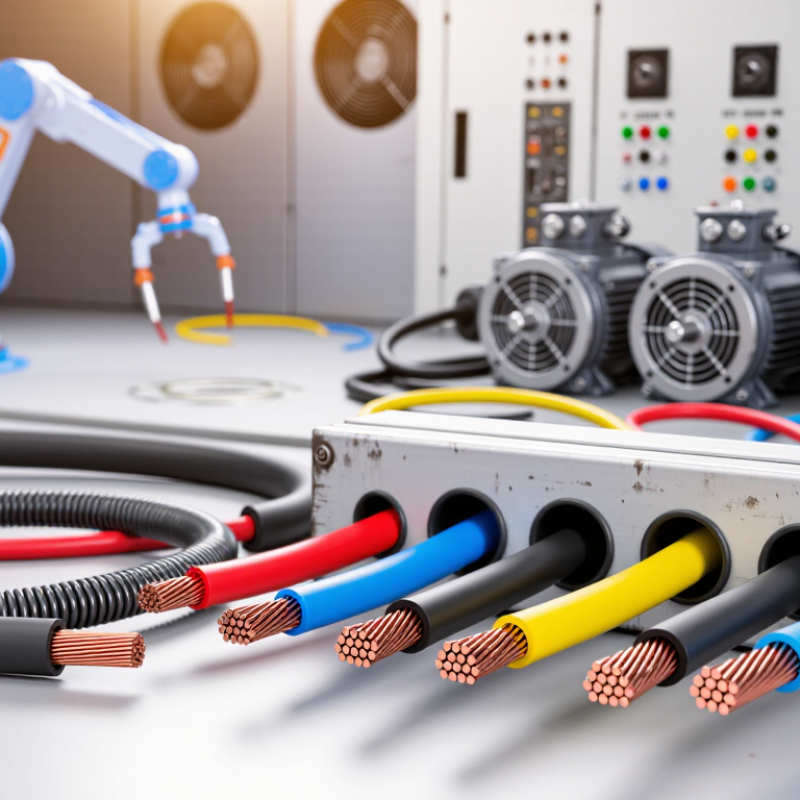
Equipment wire is not one universal product. Its type must match the machine, environment, and installation method.
Flexible PVC-insulated wire suits control cabinets, sensors, relays, and low-voltage internal connections. It is economical and easy to strip. However, it may age faster near heat, oil, or repeated movement.
XLPE-insulated wire handles higher temperatures and supports demanding power circuits. Silicone wire remains soft in cold conditions and around heat sources, but its outer surface can tear if poorly protected.
Check IEC 60227 or IEC 60245 requirements before comparing offers.
Different equipment needs different signal protection. Shielded twisted-pair wire helps reduce electromagnetic interference in drives, instruments, and automation networks. High-flex PUR or specialized robotic cable supports continuous bending in moving chains and robotic joints.
International Federation of Robotics reported 541,302 industrial robots installed worldwide in 2023.
That figure shows why motion-rated wiring deserves careful testing, not only a low price. Small details matter. Bend radius matters too.
Charging equipment creates another growing application. The International Energy Agency reported nearly 14 million electric car sales in 2023, increasing demand for durable power and control wiring.
Global buyers should confirm conductor size, voltage rating, flame performance, temperature range, and certification for the destination market.
Copper purity and strand construction affect heating and flexibility.
I once considered insulation color a minor issue; it is not. Clear identification can prevent costly maintenance errors. The best specification is sometimes less flexible than buyers expect.
The best equipment wire depends on operating conditions, not appearance or price. Start with voltage, current, temperature, and installation environment. A wire inside a dry control cabinet needs different protection from one exposed to oil, vibration, or sunlight. Conductor size should limit heating and voltage drop during continuous operation. Small details matter.
Insulation performance deserves close attention. Check the rated temperature, voltage, flexibility, flame behavior, and resistance to chemicals. For moving equipment, review bend radius and expected flexing cycles. A cable may pass a basic test yet crack after repeated movement. It can happen quietly. Shielding may also reduce signal interference near motors and power circuits. However, unnecessary shielding can increase cost and installation complexity.
Global buyers should request clear test reports, traceable material data, and certification information suitable for each destination market. Do not rely on a familiar specification alone. Regional requirements can differ, even when two products appear similar. Packaging and printing should identify size, rating, and batch details clearly. During supplier evaluation, sample the wire under realistic conditions, including heat, moisture, pulling, and repeated bending. I have found that laboratory results do not always reflect crowded machine layouts or rushed installation work. That gap deserves honest review. A technically strong wire can still underperform when routed against sharp edges or terminated poorly.
What Is the Best Equipment Wire for Global Buyers?
How Voltage, Environment, and Flexibility Affect Wire Choice
For global buyers, the best equipment wire is not the thickest or most expensive option. Voltage rating must exceed the system’s normal voltage, including expected surges. A low-voltage control circuit needs different insulation than a high-energy motor connection. Check conductor size, temperature rating, and documented test results before ordering. Small details matter. Also confirm markings and compliance documents accepted in the destination market.
Environment often changes the decision. Outdoor equipment may face sunlight, rain, salt air, dust, and repeated temperature swings. Choose insulation that resists the actual exposure, not the conditions shown in a warehouse sample. In damp areas, inspect sealing, water resistance, and termination quality together. A wire can survive moisture while its poorly fitted connector fails first. That failure is easy to overlook. For hot machinery, calculate heat from nearby surfaces and current load. Do not rely only on room temperature.
Flexibility depends on movement, installation space, and bending frequency. Fine-stranded conductors usually handle repeated motion better than solid conductors. Still, extra flexibility can increase cost and require more careful termination. Measure the minimum bend radius and leave room for service loops. I would test a sample in the real route before approving a large shipment. That step feels slow. It can reveal stiffness, cracking, or unexpected heating. Specifications are useful, but field conditions remain the honest test.
How voltage, environment, and flexibility affect wire choice
Higher voltage ratings support more demanding electrical systems, while higher continuous conductor-temperature ratings are better suited to heat, enclosed spaces, and high-load conditions. A smaller minimum bend radius generally allows easier routing in compact equipment. The figures shown are representative values for common insulation families; actual ratings depend on conductor size, insulation thickness, installation method, applicable standards, and local regulations.
What Is the Best Equipment Wire for Global Buyers?
The best equipment wire is not automatically the thickest or most expensive option. Global buyers should match conductor class, insulation, temperature rating, voltage, and flexibility to the equipment’s real operating conditions. IEC 60228 defines conductor classes, while IEC 60227 and IEC 60245 address common PVC and rubber-insulated cables. IEC 60332 testing also matters where flame propagation must be limited. Requirements can change by destination. European projects may require CE-related documentation, RoHS compliance, and EN 50575 performance evidence for construction products. North American projects often request different construction details and certification files.
Market pressure is increasing. Grand View Research reported that the global wire and cable market reached about USD 216.7 billion in 2022. Its 2023 report projected continued growth through 2030, driven by electrification, infrastructure, and industrial equipment. This growth does not make selection easier. A certificate can be current, yet the delivered reel may not match the tested construction. That uncomfortable gap deserves attention. Buyers should verify conductor material, cross-sectional area, insulation compound, batch traceability, and test dates. Request laboratory reports, not only a logo on a datasheet.
Tips: Ask for the destination market before ordering. Check the exact standard edition. Confirm metric or imperial sizing. Keep samples from every approved batch. Small details matter. A practical factory audit can reveal poor stripping, inconsistent color, or oversized insulation. These findings may seem minor, but they can delay installation and weaken long-term reliability.
| Market or Region | Wire Category | Key Standard or Regulation | Typical Voltage Scope | Main Technical Requirements | Common Verification Documents | Buyer Suitability |
|---|---|---|---|---|---|---|
| European Union | PVC-insulated single-core equipment or internal wiring cable | IEC 60227 series EN 60227 series |
Commonly up to 450/750 V, depending on the applicable construction | Conductor resistance, insulation thickness, voltage test, dimensional compliance, ageing performance, and marking requirements | Test report, declaration of conformity where applicable, technical data sheet, and batch inspection records | General equipment |
| European Union | Rubber-insulated flexible equipment wire or cable | IEC 60245 series EN 60245 series |
Commonly 300/500 V or 450/750 V, depending on the cable type | Flexibility, conductor resistance, insulation and sheath mechanical strength, heat ageing, and resistance to oil or chemicals when specified | Construction drawing, routine test report, type-test report, and material compliance declaration | Flexible applications |
| European Union | Flame-retardant wire or cable | IEC 60332-1-2 IEC 60332-1-3 where applicable |
Voltage rating is determined by the base cable standard | Vertical flame propagation performance for a single insulated wire or cable; test method and pass criteria depend on the selected part of the standard | Flame-test report identifying the exact construction, insulation material, sample size, and test method | Control panels |
| European Union | Low-smoke, halogen-reduced wire or cable | IEC 60754 series IEC 61034 series |
Voltage rating is determined by the base cable standard | Halogen acid gas emission and smoke density are evaluated only when the product specification calls for these properties | Halogen-gas test report, smoke-density report, material declaration, and product specification | Public buildings |
| European Union | Construction-installation power, control, or communication cable | EN 50575 under the Construction Products Regulation | Determined by the relevant cable product standard | Reaction-to-fire classification, factory production control, and assessment requirements apply when the cable is permanently installed in construction works | Declaration of performance, reaction-to-fire classification, notified or technical assessment documentation where required | Building installation |
| European Union | Electrical equipment wire containing restricted substances | RoHS Directive 2011/65/EU and Delegated Directive (EU) 2015/863 | Not a voltage standard | Restrictions apply to substances such as lead, mercury, cadmium, hexavalent chromium, certain flame retardants, and certain phthalates in applicable electrical and electronic equipment | RoHS declaration, material composition statement, supplier declarations, and laboratory screening where required | EU market access |
| European Union | Equipment wire containing substances of concern | REACH Regulation (EC) No. 1907/2006 | Not a voltage standard | Suppliers may need to communicate information about Substances of Very High Concern and comply with applicable restrictions | REACH declaration, SVHC communication, substance list, and supporting material records | Supply-chain compliance |
| United States and Canada | Appliance wiring material for internal equipment wiring | UL 758 CSA C22.2 No. 210 |
Voltage, temperature, conductor size, and use conditions are construction-specific | Insulation system, conductor type, temperature rating, voltage rating, flame performance, mechanical properties, and specified end use must match the recognized construction | Recognition or certification record where required, construction card, test report, and traceable product marking | OEM equipment |
| United States and Canada | Flexible cord used for portable equipment | UL 62 CSA C22.2 No. 49 |
Common ratings include 300 V or 600 V, depending on the cord type | Flexibility, conductor stranding, insulation and jacket performance, grounding arrangement, temperature rating, and mechanical durability | Certification record, cord type designation, electrical test report, and production inspection records | Portable equipment |
| International | Fire-performance cable for grouped installations | IEC 60332-3 series | Voltage rating is determined by the applicable cable standard | Flame spread on vertically mounted bunched cables; performance depends on the tested cable volume and category | Grouped-cable flame-test report with cable diameter, non-metallic material volume, installation arrangement, and category | Cable systems |
| Australia and New Zealand | Low-voltage building and equipment supply cable | AS/NZS 5000.1 where applicable | Commonly 0.6/1 kV for fixed wiring cable types covered by the standard | Conductor construction, insulation and sheath materials, current-carrying capability, mechanical performance, and marking must meet the selected cable type | Type-test report, electrical safety evidence, product marking details, and installation documentation | Fixed installation |
| Japan | Electrical appliance and equipment internal wiring | Applicable JIS standards and Japan Electrical Appliance and Material Safety requirements | Depends on the wire construction and appliance category | Insulation performance, heat resistance, flame performance, conductor size, marking, and appliance-specific safety requirements may apply | JIS test report where relevant, technical specification, material declaration, and safety documentation requested by the importer | Appliance market |
| Global buyers | Halogen-free equipment wire | IEC 60754 series and the selected product standard | Available across multiple voltage classes | Low halogen-gas emission must be confirmed separately from flame-retardant or low-smoke claims; not every flame-retardant wire is halogen-free | Material declaration, IEC 60754 test report, flame test, smoke test where specified, and product construction sheet | Sensitive environments |
| Global buyers | High-temperature silicone or fluoropolymer-insulated wire | Applicable IEC, UL, CSA, or national construction standard | Voltage and temperature ratings depend on the insulation system and construction | Continuous operating temperature, short-term temperature exposure, dielectric strength, abrasion resistance, chemical resistance, and bend radius should be verified | Temperature-index evidence, insulation material data, dielectric test report, ageing test report, and application-specific approval documents | High-temperature equipment |
Comparing equipment wire suppliers starts with the application, not the catalog. Record voltage, temperature, flexing cycles, conductor material, insulation, and installation environment. IEC 60228 defines conductor classes and resistance requirements, so ask suppliers for measured resistance data, not only nominal sizes. Small details matter.
Check compliance documents next. Request current certificates, batch test reports, traceability records, and third-party inspection results. The 2023 ISO Survey reported more than one million ISO 9001 certificates worldwide, but certification alone cannot prove consistent wire quality. Review the certificate scope and audit date. A document can look convincing.
Compare manufacturing evidence. Ask about conductor stranding, insulation extrusion, spark testing, and final inspection. For export orders, examine packaging, moisture protection, labeling, and delivery records. The International Energy Agency’s Electricity 2024 report forecasts average global electricity-demand growth of 3.4% annually from 2024 to 2026. That pressure may increase demand, but it should not excuse rushed production.
Calculate landed cost, including testing, freight, duties, rejects, and replacement delays. Then test samples under realistic conditions. Bend them, heat them, and inspect insulation recovery. I would not automatically reject the lowest quotation. Sometimes it reflects efficient production. Sometimes it hides missing tests. My own comparison sheets have also missed small logistics charges, so a second review is worthwhile. Supplier reliability is measured after delivery, not during a polished sales call.