
Choosing the right Long Distance Radios requires more than comparing advertised range. Range figures often assume open, flat ground with no interference. Real conditions are different. Hills, concrete walls, dense trees, and crowded channels can reduce performance quickly. A dependable choice begins with understanding where and how the radio will be used.
This guide examines transmission range, power options, antenna design, battery endurance, weather resistance, and audio clarity. It also considers practical details, such as glove-friendly controls and readable displays under bright sunlight. Field testing matters. A radio that works across a quiet field may struggle inside a warehouse or moving vehicle. Manufacturer specifications provide useful evidence, but independent reviews and user manuals deserve equal attention. Claims should be checked carefully.
A perfect choice rarely exists. Longer range may increase size, cost, or power consumption. Higher output power may also require compliance with local radio regulations. Users should verify approved frequencies, licensing requirements, and regional restrictions before operating any equipment. Safety remains important near roads, industrial sites, and remote terrain. Reliable communication depends on preparation, not just hardware. Test the radios with realistic obstacles, spare batteries, and agreed call procedures. Small oversights can become serious problems. This introduction provides a practical framework for comparing models honestly, recognizing both their strengths and their limitations.
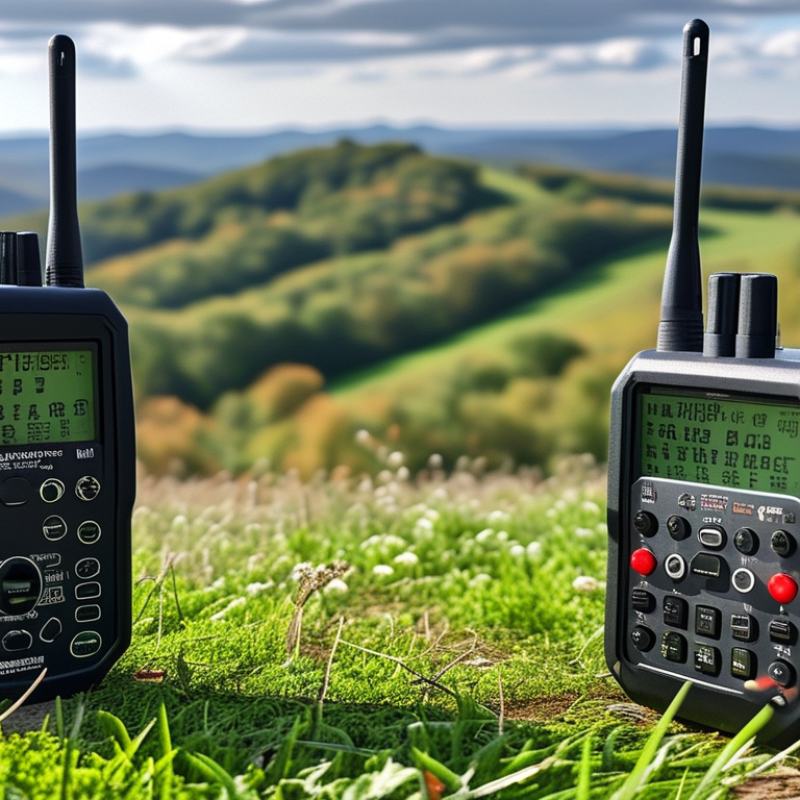
How to Choose the Best Long Distance Radios?
Start with legal power limits, not advertised distance. FCC 47 CFR Part 95 permits FRS radios up to 2 watts ERP on certain channels. GMRS systems can reach 50 watts on designated main channels. These figures describe transmitter power, not guaranteed coverage. Antenna height, receiver sensitivity, buildings, hills, and foliage often matter more.
The difference is still meaningful. In ideal free-space calculations, 50 watts could produce roughly five times the distance of 2 watts. Real terrain rarely cooperates. A concrete wall, wet trees, or a shallow valley can erase much of that advantage. The FCC Consumer Guide to Two-Way Radios also warns that range depends heavily on local conditions. Field testing remains essential.
For a hiking group, test from a trailhead to a ridge, then behind the ridge. Record clear voice, broken audio, and complete loss. A GMRS setup may suit vehicles, farms, or large properties, while FRS is simpler for short-range coordination. The FCC’s Part 95 rules should guide channel and power choices. ITU-R P.1546 propagation guidance also shows why terrain profiles improve predictions. I would not trust a box claim alone. Numbers can look precise, yet one apartment block may change everything.
Choosing the best long-distance radio starts with the landscape, not the advertised range. VHF frequencies often perform well across open fields, forests, and rolling countryside. Their longer wavelengths can travel efficiently beyond gentle obstacles. Higher antenna placement can extend coverage significantly. That advantage is practical, not magical.
UHF frequencies are often better suited to towns, warehouses, and multi-floor buildings. They can handle dense urban communication with suitable antennas and careful channel planning. However, reinforced concrete, metal walls, elevators, and underground rooms can weaken any signal. A radio that works across a parking lot may fail inside a stairwell. Terrain still matters. Even UHF performance can drop sharply behind hills or thick structures. Personal testing remains more reliable than a coverage map. I have seen expected results change after one building renovation.
Tips: Walk the actual route before choosing equipment. Test from basements, upper floors, vehicle interiors, and outdoor gaps. Compare VHF and UHF radios at the same locations. Check antenna placement, battery condition, and local frequency requirements. Keep notes. Small details reveal the real coverage limits. A higher antenna may help more than extra power. Avoid assuming one frequency suits every site. Recheck performance after adding machinery, shelving, or concrete barriers.
| Decision Factor | VHF | UHF | Practical Recommendation |
|---|---|---|---|
| Typical frequency range | Approximately 30–300 MHz. Business and land-mobile systems commonly use portions of the 136–174 MHz range, subject to local regulations. | Approximately 300 MHz–1 GHz. Business and land-mobile systems commonly use portions of the 400–512 MHz range, subject to local regulations. | Select only frequencies permitted by the relevant national or regional spectrum authority. |
| Wavelength and obstacle behavior | Longer wavelengths, typically about 1.7 m at 175 MHz, generally diffract around some terrain features more effectively. | Shorter wavelengths, typically about 0.6 m at UHF 500 MHz, are more easily affected by dense obstructions and shielding. | Favor VHF for open outdoor routes where terrain is the main concern; favor UHF where buildings and indoor structures dominate. |
| Open rural and agricultural areas | Usually efficient for wide outdoor areas with relatively few large obstructions, especially with elevated antennas. | Can perform well, but may require more attention to antenna height, line of sight, and system design. | VHF is often the starting point for farms, forestry, outdoor worksites, and extended rural operations. |
| Hilly, mountainous, or heavily wooded terrain | Often provides better diffraction around ridges and can be less sensitive to small gaps in foliage, although large mountains can block either band. | More dependent on a clear radio path; shadow zones behind hills and dense vegetation may be more pronounced. | Consider VHF, higher antenna locations, strategically placed repeaters, or a properly engineered simulcast or trunked system. |
| Concrete, steel, and multi-story buildings | May experience significant attenuation, multipath, and dead spots inside large structures. | Often better suited to building interiors because shorter antennas are practical and system planning can support indoor coverage. | Favor UHF for warehouses, hotels, schools, hospitals, factories, and urban facilities; test on every critical floor. |
| Urban streets and dense neighborhoods | Can cover outdoor routes effectively but may encounter reflections and shadowing around tall structures. | Usually handles dense urban radio paths more conveniently, but reflections and building penetration losses still require testing. | Choose UHF when users operate mainly between buildings or inside urban facilities; use repeaters for larger areas. |
| Vegetation and wet foliage | Generally less affected than higher frequencies, although heavy, wet vegetation can still reduce signal strength. | Can experience greater attenuation through dense or wet foliage, particularly on obstructed paths. | For outdoor forestry and vegetation-heavy sites, evaluate VHF first and validate performance during wet conditions. |
| Antenna size and installation | Requires a physically longer efficient antenna for the same antenna design principles, which can matter on handheld and vehicle installations. | Allows shorter antennas and compact indoor or vehicle installations, but antenna placement remains critical. | Prioritize antenna height, a suitable ground plane, low-loss feedline, and correct tuning over nominal transmitter power. |
| Expected coverage distance | No fixed distance applies. With clear line of sight, coverage can extend several kilometers; terrain, antenna height, power, and receiver sensitivity determine the result. | No fixed distance applies. Clear line-of-sight coverage can also extend several kilometers, while buildings and obstructions may reduce it substantially. | Do not select a band from advertised range alone. Perform a site survey and coverage test using the intended antennas and operating locations. |
| Line of sight and radio horizon | Radio-horizon performance is strongly influenced by antenna height; longer wavelength does not eliminate the need for a clear or suitably designed path. | Also depends heavily on line of sight and antenna height; higher frequencies may be more affected by partial obstructions. | Raise base-station or repeater antennas where possible and verify Fresnel-zone clearance for important links. |
| Interference and channel reuse | May travel farther beyond the intended service area, which can increase co-channel coordination requirements. | Often supports tighter frequency reuse in dense areas, but local interference, intermodulation, and building reflections remain possible. | Coordinate frequencies professionally and use appropriate filters, squelch settings, and licensing procedures. |
| Repeater suitability | Effective for extending coverage across rural or uneven terrain when the repeater is placed at a suitable elevation. | Effective for expanding coverage across buildings, campuses, and urban areas when indoor or rooftop antenna systems are properly installed. | Use a repeater when direct handheld-to-handheld communication cannot meet the required service area or reliability target. |
| Best-fit operating environments | Outdoor work crews, forestry, agriculture, utilities, construction sites, parks, and rural transport routes. | Commercial buildings, campuses, warehouses, hotels, schools, hospitals, factories, security operations, and urban services. | Match the frequency band to the dominant environment rather than choosing solely by claimed maximum range. |
| Primary limitations | Longer antennas, possible building penetration challenges, and greater coordination needs when signals travel beyond the target area. | Greater sensitivity to heavy obstructions and foliage on non-line-of-sight paths, plus potential multipath in reflective environments. | Use engineering, testing, and installation quality to overcome limitations; neither band guarantees universal coverage. |
Choosing a long-distance radio requires more than advertised range.
Terrain, antenna height, battery condition, and channel congestion often matter more. In open farmland, a raised antenna may outperform a higher-power handheld in a city.
DMR radios using two-slot TDMA deserve close attention. ETSI TS 102 361-1 defines two alternating voice paths within one 12.5-kHz channel. Each slot occupies half the transmission time, creating a 6.25-kHz-equivalent efficiency.
That design can support two conversations without requesting two separate channel assignments. The FCC’s narrowbanding framework also established 12.5 kHz as a key benchmark for land-mobile systems.
Efficiency matters where spectrum is limited.
Check the details.
A practical comparison should measure coverage at ground level, not only laboratory range.
ITU-R propagation guidance shows that buildings, vegetation, and terrain can sharply reduce reliable signal distance. Test radios along the actual route, including stairwells, valleys, and vehicle interiors. Listen for clipped speech and delayed audio. Those faults are easy to miss during a short demonstration.
Some specifications also quote ideal battery life, which may fall substantially with frequent transmitting and GPS use.
I have found that a slightly heavier radio with a clearer speaker can be more useful than a lighter model with impressive range claims. The “best” choice is not always the longest-ranging one.
How to Choose the Best Long Distance Radios?
A long-distance radio must survive more than a strong signal test. Dust, rain, drops, and heat can quietly weaken field performance. IP68 is a useful starting point. Under IEC 60529, “6” means dust-tight protection. The “8” indicates continuous water immersion, but the depth and duration depend on the manufacturer’s stated conditions. That detail matters. IP68 does not mean unlimited underwater use.
MIL-STD-810H adds practical stress testing. Relevant methods include high temperature, low temperature, vibration, and shock testing. However, this standard is not a single durability certificate. Manufacturers must identify the exact methods and conditions used. A 2024 industry market report estimates the rugged-device sector could grow from roughly 3.7 billion dollars in 2023 to 5.2 billion dollars by 2028. The trend reflects growing demand in logistics, utilities, construction, and emergency communications. Yet a high rating alone cannot prove reliable field service.
Tips: Ask for the test report, not only the logo. Check immersion depth and time. Review the tested drop height and surface. Inspect the battery door, antenna seal, speaker grille, and charging contacts. Test a sample in cold rain, not just in a showroom. I have seen radios pass a water test but fail after repeated drops. That assumption is easy to make. A perfect rating is not a perfect radio. Compare the test conditions with your actual worksite before choosing.
When choosing the best long distance radio, battery life deserves more than a headline number. The 5-5-90 duty cycle offers a practical comparison method. It assumes 5% transmitting, 5% receiving, and 90% standby. This pattern reflects many field situations, including short calls, regular listening, and long quiet periods.
Check the radio’s current draw in each mode. A simple estimate uses the weighted average of transmit, receive, and standby consumption. For example, a 2,000 mAh battery may appear to last more than fifteen hours under ideal conditions. Real use can be shorter. High volume, weak signals, cold weather, and frequent channel scanning all increase drain. Keep those details in your test notes.
I once trusted a manufacturer’s standby figure and planned a full workday around it. The radio failed before the shift ended. My mistake was treating standby as the main workload. In practice, repeated transmissions and poor reception changed the result quickly. Test the radio with the same antenna, distance, volume, and operating schedule you expect in the field. Carry a spare battery when communication matters. The 5-5-90 model is useful, but it is not a promise. Conditions are rarely perfect.
Evaluate battery life using the industry-standard 5-5-90 duty cycle.
The 5-5-90 duty cycle represents 5% transmitting, 5% receiving, and 90% standby time. Use this consistent usage profile when comparing radio battery performance. Actual runtime also depends on battery capacity, transmit power, signal conditions, temperature, and device efficiency.