
Choosing the right Mcb Insulation Tester is more than comparing prices or reading a product label. The instrument must match the circuit, testing environment, and safety requirements of the work. A reliable tester helps electricians identify weakened insulation before leakage current becomes a serious problem. It can also support routine maintenance records, commissioning checks, and fault investigation.
Look beyond the display and advertised voltage range. Check whether the tester provides suitable insulation test voltages, accurate resistance readings, automatic discharge, and clear warning signals. A firm grip matters when testing inside a crowded distribution board. So does a bright screen under poor lighting. Experienced technicians also examine lead quality, probe insulation, battery life, calibration information, and protection against accidental live contact. Small details matter.
The safest choice depends on actual field conditions. A tester used for residential MCB circuits may not suit industrial panels, control cabinets, or long cable runs. Confirm the equipment’s CAT rating and follow the manufacturer’s instructions before testing. De-energize the circuit, isolate connected electronics, and verify zero voltage with an approved instrument. Do not rely on one reading alone. Record the test voltage, measured resistance, temperature, and circuit identification.
Some selection decisions remain imperfect. Marketing claims can sound convincing, while long-term durability is harder to judge. An inexpensive model may appear practical, but poor probes or unstable readings can increase risk. This guide examines the technical features, safety controls, accuracy expectations, and practical limitations that shape a dependable Mcb Insulation Tester choice. Real work is rarely tidy. Good testing equipment should still perform clearly when conditions are not.
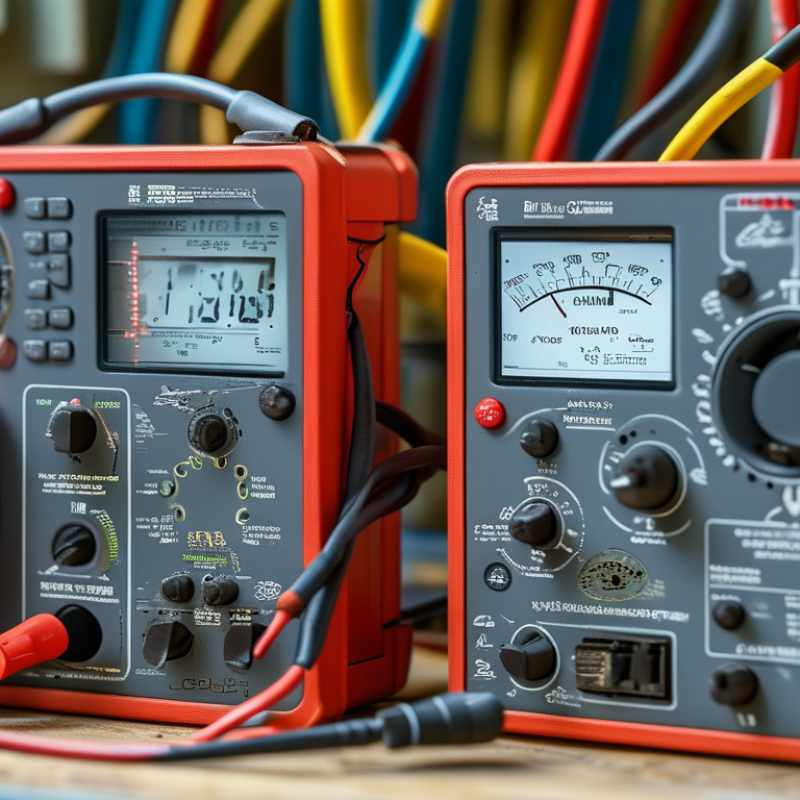
An MCB insulation tester measures resistance between live conductors, neutral, and earth. It applies a controlled DC test voltage to reveal weakened insulation. A healthy circuit usually shows high resistance, while a low reading may indicate moisture, damaged cable, or a loose connection. The MCB itself protects against overcurrent, but it does not prove that insulation is safe. That difference matters.
Choose a tester with suitable test voltages, commonly 250 V, 500 V, or 1,000 V. The correct setting depends on the circuit and connected equipment. A built-in discharge function is important because cables can retain dangerous charge after testing. Look for clear digital readings, stable probes, and a suitable measurement category rating. Test leads should feel secure, not merely look polished.
Before testing, isolate the circuit and verify that no voltage remains. Disconnect sensitive electronics when required. Record the reading, temperature, circuit location, and test voltage. Field work often exposes a simple mistake: testing too quickly and overlooking a damp junction box. I have found that careful visual inspection can explain a reading better than repeated button presses. Do not treat insulation testing as an MCB trip test; they answer different safety questions. Accuracy also depends on clean probe contact. Small details matter.
A practical comparison table for selecting an insulation tester for miniature circuit breakers and low-voltage electrical circuits
| Selection Dimension | What to Look For | Typical Technical Values | Why It Matters | Suitable Use |
|---|---|---|---|---|
| Primary Function | Dedicated insulation-resistance measurement with a controlled DC test voltage | Insulation resistance measurement, continuity testing, and DC voltage verification | Confirms whether insulation is adequately separating conductors and reducing leakage-current risk | Routine testing of MCB circuits, distribution wiring, and control circuits |
| Test Voltage Selection | Choose a voltage appropriate for the circuit's rated voltage and the manufacturer's instructions | Common selectable settings: 250 V DC, 500 V DC, and 1,000 V DC | The selected voltage must be high enough for a meaningful test but not harmful to connected equipment | 250 V DC for sensitive or lower-voltage circuits; 500 V DC for many low-voltage installations; 1,000 V DC where permitted |
| Insulation-Resistance Range | A broad measurement range with clear units and automatic range selection | Typical instruments cover values from the megohm range up to several gigohms, depending on test voltage | Allows detection of both seriously degraded insulation and high-resistance insulation | New-installation verification, periodic maintenance, and fault investigation |
| Measurement Accuracy | Published accuracy specification for insulation resistance and voltage output | Many professional instruments specify accuracy as a percentage of reading plus a number of counts | Reliable accuracy supports consistent pass/fail decisions and trend monitoring | Required when test results must be documented or compared over time |
| Continuity Test | Low-resistance continuity function with an audible indication | Typical continuity thresholds are below 50 ohms; many testers use a low test current for this function | Helps verify protective conductors and bonding before applying an insulation test | Protective earth, bonding, and conductor continuity checks |
| Live-Circuit Detection | Automatic detection and inhibition when voltage is present at the test terminals | AC/DC voltage detection with a warning display or audible alarm | Prevents inappropriate insulation testing on energized circuits and helps protect the operator | Essential for field work and testing circuits that may be incorrectly isolated |
| Discharge Function | Automatic discharge of stored energy after the test is complete | Discharge begins when the test button is released or when the test cycle ends | Cables and connected components can retain charge after a DC insulation test | Safer testing of long cable runs and circuits with significant capacitance |
| Safety Rating | Measurement category and working-voltage rating suitable for the installation location | Common professional ratings include CAT III 600 V or CAT III 1,000 V; the exact rating must be checked on the instrument | Indicates the transient environment in which the tester is designed to be used | CAT III is commonly associated with fixed-installation distribution and branch circuits |
| Applicable Standards | Evidence of conformity with relevant electrical measuring and insulation-testing standards | IEC 61557-2 addresses insulation-resistance measurement; IEC 61010-1 covers safety requirements for electrical measurement equipment | Standards help define measurement performance, protection, and test-method expectations | Professional inspection, commissioning, maintenance, and compliance records |
| Test Current and Output Stability | Stable DC output and a controlled test current suitable for the intended circuit | Many instruments provide a test current in the milliampere range during insulation testing | Stable output improves repeatability and reduces misleading readings caused by fluctuating test conditions | Comparative testing across multiple MCB-protected circuits |
| Test Timer and Pass/Fail Features | Timed tests, automatic measurement hold, and configurable comparison limits | Common timer settings range from several seconds to one minute or more | Standardizes test duration and makes results easier to compare between circuits | Maintenance programs, quality-control inspections, and repeated field testing |
| Data Recording | Internal memory, result hold, timestamping, or USB/Bluetooth transfer | Basic models may store a limited number of results; advanced models can export test records | Creates traceable documentation for commissioning and maintenance | Installers, facility engineers, inspectors, and service teams |
| Probe and Lead Design | Insulated test leads, finger guards, secure probes, and durable cable insulation | Use leads rated for the tester's voltage and measurement category; fused leads may be appropriate for some functions | Good lead design reduces accidental contact and improves connection reliability | Frequent on-site testing in distribution boards and confined work areas |
| Environmental Protection | Ingress protection, operating-temperature range, and resistance to dust and moisture | Many rugged handheld testers provide an IP rating such as IP54, but the rating varies by model | Protects the instrument when used in construction, plant rooms, and service environments | Field maintenance and industrial electrical inspections |
| Power Supply | Battery life, battery indicator, automatic power-off, and easy battery replacement | Most handheld testers use replaceable or rechargeable batteries and include a low-battery warning | Prevents interrupted testing and helps avoid inaccurate results caused by insufficient power | Portable inspection work and service calls |
| Physical Design | Clear display, backlight, one-handed operation, and compact protective housing | Prefer a display that clearly identifies test voltage, resistance, voltage presence, and measurement units | Improves readability and reduces operating errors inside crowded electrical panels | Routine troubleshooting and testing in areas with limited lighting |
| Compatibility with Connected Loads | Ability to isolate or protect sensitive electronic devices before testing | Disconnect surge-protection devices, electronic controls, dimmers, drives, and other equipment when required | Insulation-test voltage can damage components that are not designed to receive it | Always follow circuit diagrams and equipment instructions before testing |
| Result Interpretation | Use installation standards, equipment instructions, and documented baseline values | Higher insulation resistance is generally preferable, but no universal pass value applies to every installation | Limits depend on circuit voltage, wiring type, connected equipment, and the governing standard | Do not judge a circuit from the tester display alone |